
When I was a kid, I loved the choose-your-own-adventure books. I liked the idea that you could read them again and again and not read the same book twice (which was sort of true). More than that, I liked the agency they gave me; when I read them, the imaginative experience was explicitly active (though I would never have described it like that back then). Reading a good book is always an adventure, but with those, it was my adventure.
I like to think that choosing a Common App essay topic is a little like that. You get to choose the essay adventure that you're about to embark on! Do you want to go deeper into the cave of time or not? (Spoiler alert: it doesn't matter. You've already been transported back into prehistory.)
In the choose-your-own-adventure books, each decision you made would send you to a different page with a new twist or storyline. They almost always ended in grisly death, but it was fun to go back and try to avoid making the mistakes.
Oh no, I've gone so far back in time that the earth has no oxygen! Not again! I'll go to page 42 instead. Shucks, looks like this time I've gone back to ancient China where I will be worked to death building the Great Wall.
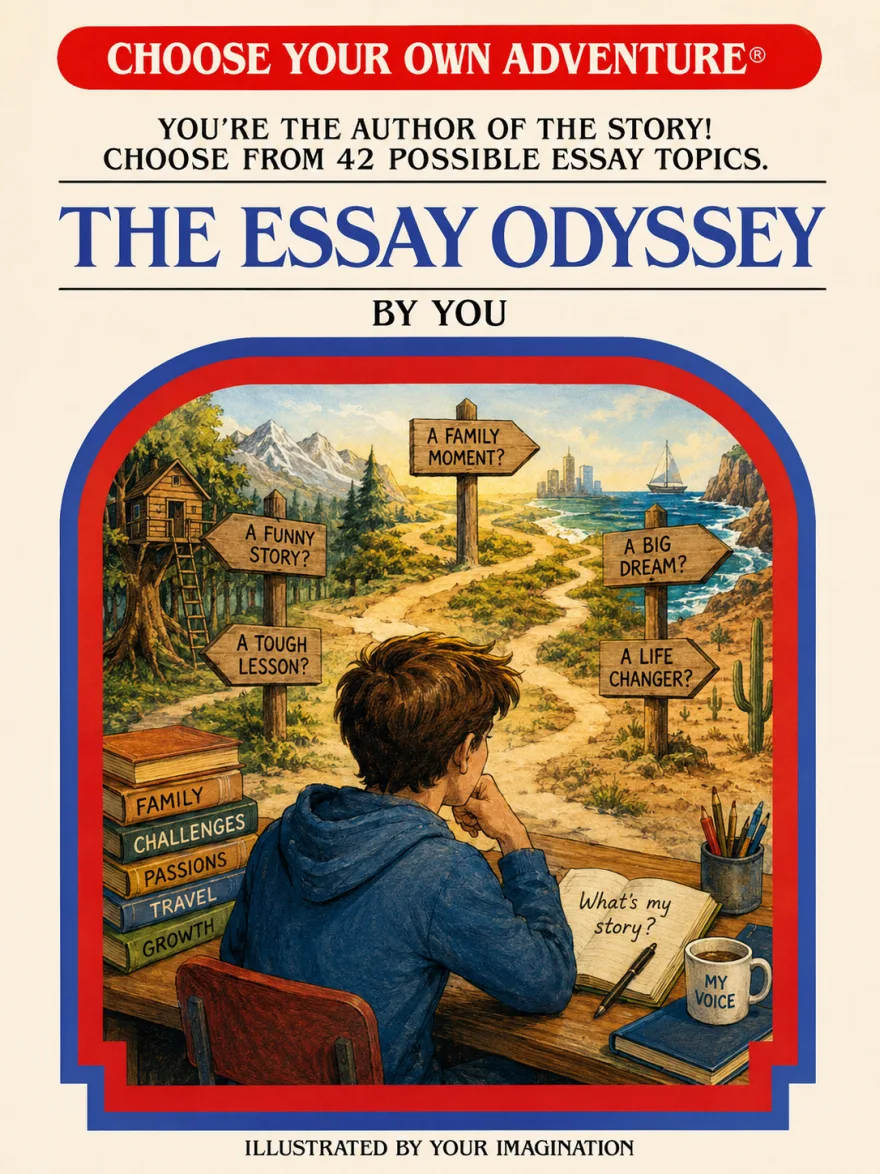
Writing your college essay does not have such high stakes. But the process does begin with a consequential decision, which determines quite a bit about everything that follows, and it's a decision you may have to go back and make again, maybe even several times.
Of course, I'm talking about picking a topic.
This is not the same as choosing a prompt, although it is related. (We'll get to that later.) But it is a place where you have a decision to make. You have probably already started thinking about it. Maybe you have a list of seven topics and every one of them feels half-right. Maybe you have nothing, a blinking cursor, and a growing certainty that everyone else figured this out already.
You have probably also heard the standard (terrible) advice: “Choose a meaningful topic.” “Pick a story that represents who you are.” “Write about an experience that shows growth.”
All of that relies on a false assumption: that the topic is already out there, perfect, finished, on a shelf somewhere just waiting for you to come along and pick it up. But writing doesn't actually work like that. The topic you should write about doesn't exist yet, because you haven't written the essay yet. It's not a question of deciding what to write about. You won't be able to decide until you start writing.
This is how writing actually works, and it's one of the most settled findings in the research on how people write.
You're probably going to have to choose again, anyway. If you want to write about an obstacle you've encountered that taught you a lesson, open the door behind prompt number two. If you want to write about how someone made you grateful, try door four.
Stuck between ideas, or stuck with none? Book an Essay Kickstart Session and leave with a topic direction you arrived at by writing, plus a plan for the summer.
Why “Just Pick a Topic” Is Bad Advice
In 1973, the writing teacher Peter Elbow described the model for what writing is that most people carry in their heads. First, you figure out what you want to say, then you put it into words. He called this model “backwards,” and he was blunt about the damage it does. “This idea of writing is backwards,” he wrote. “That's why it causes so much trouble.”
His replacement is the line worth taping above your desk. “Meaning is not what you start out with but what you end up with.” You begin writing before you know your point. Doing the writing is what produces the point. As Elbow put it, writing is “a way to end up thinking something you couldn't have started out thinking.”
Donald Murray, who spent decades teaching this, called the whole activity “the process of discovery through language” and “the process of exploration of what we know and what we feel about what we know.” Notice the word discovery. You are not retrieving a topic you already own, which you have simply misplaced, forgotten on a shelf in some dusty closet. You are discovering something new.
The researcher Sondra Perl watched students compose sentence by sentence and found the same thing happening in real time. “Writers know more fully what they mean only after having written it,” she wrote. The words on the page become “a window on the implicit sense with which one began.” When you start, you have a vague sense of what you want to say, what matters to you, what you think. Writing is how you find out what it actually is.
That means that you can stop staring at your list of seven topics. The answer isn't on there. The list isn't the answer, it's what you have instead of an answer, and you'll only find your real topic by exploring your ideas more deeply, by writing about them, making choices, traveling back in time or perhaps into another dimension.
The Trap of Picking Too Early
There's a second reason deciding too early backfires, and there's research on that too. It's a bit like the thing that separates strong writers from weak ones.
Linda Flower and John Hayes studied writers thinking aloud as they worked. They found that less effective writers tend to get “chained to the topic” and “locked in by the myopia in their own goals.” They commit to a narrow idea early and then can't see past it. Stronger writers keep their goals “inclusive and exploratory” for longer. They let the topic stay loose while they learn what it wants to become. (If something goes wrong and they find themselves being chased by a dinosaur, they choose a different adventure instead.)
Maybe the most useful thing Flower and Hayes found is this. “In the act of writing, people regenerate or re-create their own goals in the light of what they learn.” Good writers change their minds as they go. They let the essay teach them what it wants to be about, and they follow it there.
This is why the student who locks in “I'll write about my soccer injury” on day one often ends up with something flat and boring, while the student who freewrites about a soccer injury discovers the real subject is the week afterward when nobody needed her and she didn't know who she was without the team. They started with the very same idea, on the very same page, but the second student chose to go into the cave of time.
So the goal of topic selection is not to decide fast. It's to explore for long enough that the real subject of the essay has a chance to surface. Here is how to do that.
Three Exercises That Surface a Topic
These are not brainstorming gimmicks. Each one is a way of writing toward a topic instead of just choosing one blindly. Do these exercises in order, or do whichever one fits where you're stuck. None of them demands finished writing, only that you keep your hand moving.
Exercise 1: The 10-Minute Freewrite
Set a timer for ten minutes. Pick anything to start, a moment or an argument you still replay in your head, even just “I don't know what to write about.” Then write without stopping. Don't reread. Don't fix typos. Don't decide whether it's good. If you run dry, write “I'm stuck” until something else comes.
The point is to separate producing from judging. Elbow's core finding is that freewriting “undoes the ingrained habit of editing at the same time you are trying to produce.” When you stop editing yourself mid-sentence, your actual voice and your actual material start showing up. Most of what you write will be ordinary. That's expected. As Elbow noted, “the good bits will be much better than anything else you can produce by any other method.” You're mining. (You've chosen the page where you travel back into the past to become a gold miner.) Dig for long enough, and you'll strike something valuable.
After ten minutes, stop and read it back. Underline the one sentence that feels most alive, the one that surprised you a little. That sentence is your seed for the next exercise.
Exercise 2: Looping
Looping is freewriting, chained. It's the single best exercise for a student with too many topics or none, because it drills a vague idea down to a specific one that you probably actually have something to say about.
Here's how it works. Do a freewrite. Read it back and find the sentence with the most life in it, what Elbow calls the “center of gravity.” Copy that sentence to a fresh page and freewrite again, starting from it. Don't return to your original topic. Follow the new sentence wherever it goes. Then do it a third time. Find the new center of gravity, and loop once more.
After two or three loops, put your final sentence next to the topic you started with. The distance between them is the point. You almost always end up somewhere you could not have named at the start, and that ending place is usually your real subject. The mechanism, in Elbow's terms, is that each round lets “one piece of material be transformed by interacting with another,” which is how “a piece of writing can start out X and end up Y.”
If you have seven topics, run a loop on the two or three that tug at you most and see which one keeps generating. If you have none, start a loop from something small and concrete, a smell, an argument, one particular Tuesday when you were miserable and didn't want to go to school, and let whatever it is pull you somewhere unexpected. The topic that keeps producing is the topic that wants to be written.
Exercise 3: Cubing
Cubing is a practical way to look at one subject from six angles fast, so you don't flatten it into the first obvious version. Take a topic you're considering and spend two or three minutes writing on each of these six moves:
- Describe it. What does it look like and feel like up close?
- Compare it. What is it like or unlike?
- Associate it. What does it remind you of? Where does your mind go?
- Analyze it. What is it made of? What are its parts?
- Apply it. What is it good for? How does it work in your life?
- Argue it. Take a position on it. Defend it or challenge it.
Six short bursts, one subject. Cubing is useful when you have a topic but suspect you're only seeing its surface. The “associate” and “argue” faces in particular tend to crack a familiar subject open and show you the version worth writing. (Cubing is a practical heuristic, not a research finding. Use it as a tool, not a rule.)
A related quick tool is the “What If” question. Take your subject and bend it: What if this hadn't happened? What if I'd chosen differently? What did I believe before this that I don't believe now? These questions push you off the expected story and toward whatever is turning underneath it.
How to Tell You've Found the Right Topic
After exploring, you'll usually have two or three candidates that survived. Here's how to choose between them.
The topic that excites you to write is almost always the right one. Not the most impressive one. Not the one you think admissions officers want. The one that, when you start writing about it, gives you more than you expected. Think energy. Think electricity. Flower and Hayes found that good writers follow what they “learn” while drafting and regenerate their goals around it. If one topic keeps surprising you, teaching you things, and another keeps stalling, that's your answer. Surprise is the signal.
The right topic reveals you, not just an event. A topic is not a story about a thing that happened. It's a window into how you think. The soccer injury is an event. What you understood about yourself in the weeks after is the topic. If your candidate essay topic has a “so what” feeling that you can't stop thinking about, keep it.
The right topic is specific enough to be only yours. If your draft could have been written by a hundred other applicants with the same activity, the same soccer injury, then you've picked the event and not the person. The fix is rarely a new topic. (You don't have to go back to page 42 again). Instead, go deeper into your idea, usually through another loop.
The Swap Test (For Supplemental Essays)
This one is for the supplemental essays, especially “Why this school?” prompts, and it's a practical test rather than a research finding.
Write your draft, then swap the school's name for a different school's name. If the essay still makes sense, it isn't done. A real “Why us” essay should fall apart the moment you change the school, because it's built on specifics only true of that one place, a named professor, a particular program, a class you'd take. If your essay survives the swap, you've written a generic essay with a school name pasted on top. Go back and replace every interchangeable sentence with something only true of this school.
Matching Your Topic to a Common App Prompt
Here's the part that trips people up, and the order matters. Don't pick a prompt and then hunt for a story to fit it. Explore first, find your real subject, then find the prompt it already answers. The 2026-2027 Common App prompts are broad enough that a genuine topic almost always fits one of them, and Prompt 7 (“an essay on any topic of your choice”) exists precisely so a strong essay never has to be forced into a box.
A rough guide to which prompts tend to favor which kinds of subjects:
- A subject about who you are at your core tends to fit Prompt 1 (background, identity, interest, talent). The trap is writing about the thing instead of the person behind it.
- A subject built around a hard moment and what came after fits Prompt 2 (challenge, setback, failure). The essay lives in the “after,” not the event.
- A subject where you changed your mind fits Prompt 3 (questioning or challenging a belief). The body of the essay is the questioning itself, not the tidy resolution.
- A subject about a person or moment that changed you can fit Prompt 4 (gratitude), as long as you stay the subject and the other person stays the catalyst.
- A subject about a turning point in self-understanding fits Prompt 5 (accomplishment, event, or realization that sparked growth).
- A subject you genuinely lose yourself in fits Prompt 6 (a topic that makes you lose track of time). This one rewards real intellectual curiosity over performed passion.
For a full breakdown of the seven prompts and their common traps, see our guide to starting your Common App essay.
One More Thing: Keep Your Exploration
As you freewrite and loop your way to a topic, save the work. Don't delete the loops that didn't make it. There's a practical reason beyond sentiment. The exploration is a record of your thinking, and in an era where families and admissions officers are both wary of AI-written essays, the ability to show how your topic emerged is worth having. The student who can point to three weeks of freewrites that led to a topic has something an AI-generated essay can never produce: a paper trail. Documentation. We wrote about why that paper trail matters in our guide to how students should (and shouldn't) use AI.
The Short Version
Stop trying to pick. Start exploring. Freewrite for ten minutes on a few candidates, loop the ones with life in them, and watch which subject keeps generating more than you expected. The topic that surprises you, the one that you can't stop writing about, is the one to write. You won't choose it. You'll find it.
Want a coach in the room while you do this? A Kickstart Session walks you through these exercises live and helps you leave with a topic direction and a plan.
Sources
The research quoted in this article, with the pages each quotation comes from.
- Peter Elbow, Writing Without Teachers (1973). The “backwards” model of writing and “meaning is not what you start out with but what you end up with,” p. 15. Freewriting as undoing the habit of editing while producing, p. 6. “The good bits will be much better,” p. 8. Looping, the “center of gravity,” and writing that starts out X and ends up Y, pp. 48-49.
- Donald Murray, “Teach Writing as a Process Not Product,” The Leaflet (1972). Writing as “the process of discovery through language,” p. 2. Murray's estimate that prewriting takes about 85% of a writer's time comes from the same essay.
- Sondra Perl, “The Composing Processes of Unskilled College Writers,” Research in the Teaching of English (1979). “Writers know more fully what they mean only after having written it” and the page as “a window on the implicit sense with which one began,” p. 331.
- Linda Flower and John R. Hayes, “A Cognitive Process Theory of Writing,” College Composition and Communication (1981). Writers “chained to the topic” versus “inclusive and exploratory” goals, p. 379. Writers who “regenerate or re-create their own goals in the light of what they learn,” p. 381.