
Spring is the season when there is still plenty of time. The 2026-2027 Common App essay prompts have just come out. Nobody feels any pressure. Everything is lovely and every idea seems like a good one.
Motivating yourself when deadlines are still far away can be tough. Families often assume application season doesn't kick off until the common app opens on August 1st. But writing well takes time, there are no shortcuts, and the strongest essays are the ones that get started in the spring.
Use these months for structured brainstorming, topic exploration, and developing a clear essay idea. Students who do this now will already have a clear sense of what they want to say when the summer comes around and everyone else is just getting started. Waiting until August, on the other hand, compresses the entire process into a few stressful weeks. Doing it that way, under pressure, without the freedom to be creative and try out ideas, always produces more dull, generic, unmemorable essays, essays that are less likely to catch the attention of admissions readers.
Need help getting started? Book an Essay Kickstart Session and leave with a topic direction, a working outline, and a clear plan for the summer.
Here's how.
The 2026-2027 Common App Essay Prompts (All 7)
The Common App gives students seven prompts to choose from, with a 650-word limit. Fortunately, you only need to address one of them—but you might not know which one yet, and it's a good idea not to choose too soon.
Prompt 1: Some students have a background, identity, interest, or talent that is so meaningful they believe their application would be incomplete without it. If this sounds like you, then please share your story.
Prompt 2: The lessons we take from obstacles we encounter can be fundamental to later success. Recount a time when you faced a challenge, setback, or failure. How did it affect you, and what did you learn from the experience?
Prompt 3: Reflect on a time when you questioned or challenged a belief or idea. What prompted your thinking? What was the outcome?
Prompt 4: Reflect on something that someone has done for you that has made you happy or thankful in a surprising way. How has this gratitude affected or motivated you?
Prompt 5: Discuss an accomplishment, event, or realization that sparked a period of personal growth and a new understanding of yourself or others.
Prompt 6: Describe a topic, idea, or concept you find so engaging that it makes you lose all track of time. Why does it captivate you? What or who do you turn to when you want to learn more?
Prompt 7: Share an essay on any topic of your choice. It can be one you've already written, one that responds to a different prompt, or one of your own design.
These are the same prompts as last year, which is good news. There is a lot of excellent guidance already available, and no one is scrambling to figure out a brand-new question. The best thing you can do, at this stage, is to identify the core of the story you want to tell. Figuring this out will naturally lead you to the best prompt.
What's Worth Knowing About These Prompts
A few things that aren't obvious on first read.
Prompt 1 is the most popular and also probably the hardest to do well. "Background, identity, interest, or talent" sounds pretty open-ended, and it is. The trap is describing the thing itself (your love of piano, your cultural heritage, your sport) rather than what it reveals about the way you think and how you move through the world. The strongest Prompt 1 essays center on the person behind the topic, not the topic itself.
The Deceptive Difficulty of Prompt 4 (Gratitude)
Prompt 4 needs a word because it catches students off guard more than any other prompt. The question asks you to reflect on something someone has done for you that made you "happy or thankful in a surprising way." Easy right? It sounds warm and accessible and choosing this will probably make you sound like a nice person, you might think. But in practice, this is usually one of the hardest prompts to execute well.
The most common mistake is writing a tribute to someone who helped you, describing a generous teacher, a sacrificing parent, or a loyal friend, and making sure to reveal how amazing they are. By the end, the reader knows a lot about them and very little about you. The prompt wants you to trace how gratitude reshaped your thinking or actions. The other person is the catalyst. You have to be the subject.
A strong Prompt 4 essay identifies a specific moment of unexpected gratitude—doesn't matter what kind, how small or how large—then follows the chain of what that moment set in motion. How did it alter the way you see a relationship, a responsibility, your own assumptions? The focus has to stay on your internal shift, not what sparked it.
What Else to Watch For
Prompt 7 ("topic of your choice") is sometimes treated as a wildcard or a safety valve. It works best when your strongest story genuinely doesn't fit the other six prompts. If you're using Prompt 7 because you can't decide, that's usually a sign you need more brainstorming time.
The most important thing to understand about all seven prompts is this: you should start by exploring what you want to write about, not by choosing a prompt. The right prompt becomes obvious once you know your story. Working backward, from prompt to topic, is one of the most common reasons essays feel forced.
If you want a deeper look at how to move from brainstorming to a final topic, see our guide on how to choose a Common App essay topic.
Why Starting Early Changes Everything (The Science of Discovery)
In 1981, a pair of my fellow writing nerds (we prefer to call them composition researchers) named Linda Flower and John R. Hayes published a landmark study on how writers actually think. They found that skilled writers don't follow a neat, linear path from brainstorming to drafting to revising. Instead, they cycle through planning, generating ideas, and evaluating their work in overlapping waves. Their writing process was messy and recursive, and that was precisely what made it productive.
This matters for writing a college essay because the standard approach (sit down in August, pick a prompt, write a draft) skips all the discovery-stage work, which is probably the most important phase.
Discovery is the foundation of every strong essay. This is the part where you generate the raw material, the half-formed ideas, the lightbulb moments that make your essay yours. You have to sit with your thoughts for a while—while keeping your fingers busy at the keys. You might try one topic, then realize the essay is actually about something else entirely. Things develop. You can't rush this part. Taking your time here is the difference between submitting an essay that sounds like a polished version of the first thing you thought of and submitting an essay that reveals something genuinely surprising about who you are.
Students who start discovery in the spring give themselves the one resource money can't buy: time to think. By the time the Common App opens on August 1st, they have pages of notes, a clear topic, and maybe even a working outline. For them, drafting the essay over the summer months is calmer, more fun, more of a creative exercise and less of a struggle, because they have already done the hardest part: figuring out what to say.
How Account Rollover Makes a Spring Start Possible
One practical question. Can you actually begin the process before the Common App opens on August 1st? Absolutely! The Common App supports account rollover, which means students who create an account now will retain their information when the new application cycle goes live. If you're the kind of person who needs to see the application itself, get in there and get started. You can paste the final version of the essay in later.
That leaves no logistical excuse for waiting. You can brainstorm in March, outline in May, draft in June, and have a working essay ready to paste into the application the day it opens. The only thing that changes on August 1 is the submission button.
A Six-Stage Framework for Getting Ahead
Don't put it off! You don't have to write the essay in a single chaotic sprint. Your results will be better—and you'll enjoy it more—if you follow a structured process that breaks the work into stages, each with a clear purpose.
This framework is based on fifty years of composition research and on my ten years spent teaching writing as a college professor. The number of college students I have seen suffering over deadlines… is beyond counting. But the best essays were all—always—written with a strong process.
These are the six stages I used in my college writing classes, adapted specifically for the application essay.
Discovery. Come up with ideas through freewriting, brainstorming, "What if…" questions, and other exploratory tools. This is where your topic emerges. The only goal is to generate material without evaluating it. Students often return to this stage even after a first draft is written, and that is completely normal. You might draft a paragraph about one memory and realize it unlocks a completely different topic worth exploring.
Structuring. Once you have a topic, choose the right essay structure to tell your story. A narrative arc, a montage of connected moments, or an iterative structure that shows growth over time. This stage is about developing genre awareness, understanding what different essay shapes can do and choosing the one that serves your particular story best. The right structure makes your content land. The wrong one buries it.
Drafting. Write the first full draft. It will be imperfect, and it should be. The goal is to get your ideas down in a form you can work with. First drafts are raw material for revision.
Revision. This is where the real improvement happens. Revision means rethinking your ideas and structure. It means asking hard questions. Is the most important moment getting enough space? Does the essay show what changed in me? Does the ending land with enough weight? Research shows that expert writers revise at the level of ideas and organization, while novice writers stop at word-level changes.
Polish. Sentence-level editing. Word choice and rhythm. This is the stage most students start with, which is why so many essays are grammatically correct but emotionally flat. Polish works best after the ideas and structure are already sound.
Reflection. Most people never get here, but this is probably the most important. After the essay is finished, reflect on what you learned about your own writing process. Which strategies worked? Where did you get stuck? Reflecting on the process builds the kind of self-awareness that transfers to college-level writing and professional communication for years afterward. Parents paying for coaching should know that this is where the long-term value lives. An essay might get a student into college, but the writing skills they develop through reflection are what they carry with them once they're there.
Don't try to do it all at once! That's how lots of writers get stuck. Finding a topic, then a structure to shape it, and then writing polished sentences are all different tasks with different cognitive demands. Separating them lowers the pressure at each stage and produces better work.
Part of this is your coach's job. That is to say, my job! It can be hard to know where you are in the process, or what work to do at each stage, without someone who can guide you. But the basics are easy. Discover first, structure next, revise deeply for ideas and for structure, polish last. Following that process will take away a lot of the stress and help turn writing the college essay into something manageable, maybe even fun (if I can go out on a limb).
The good news is that stages 1 and 2, Discovery and Structuring, can happen right now, in March, April, and May. You don't need the Common App to be open. You don't need to know your school list. You just need to take the leap and start exploring.
What to Do This Month
If you're a rising senior reading this in March or April 2026, here's where to begin.
Set a timer for ten minutes and freewrite. Pick a moment from the past two years that you keep thinking about and then write continuously about it without stopping or editing. The goal is to discover what you actually want to say, and that happens through the act of writing itself. Peter Elbow, one of the most influential writing teachers (or writing nerds, if you prefer) of the last fifty years, calls this "writing to learn." You won't know what you think until you see what you write.
Try the "What If…" exercise. Ask yourself generative questions that push you past the obvious. "What moment has a clear 'before me' and 'after me'?" "What do I know about now that I didn't know about a year ago, and how did I learn it?" "If someone followed me around for a week, what would surprise them?" These sorts of questions are designed to pull out material you wouldn't find by staring at the seven prompts.
Talk to someone who knows you well. Ask a parent, a friend, a teacher, or a coach: "What do you think I'd write about if I had to explain who I am to a stranger?" You'll be surprised at what other people notice about you. Sometimes the most interesting essay material is so close to home and to who you are that you can't see it yourself.
Don't pick a prompt yet. Resist the urge to lock in a topic or a prompt too early. Give yourself permission to explore for at least two to three weeks before evaluating. The right topic almost always reveals itself through the process of writing, not through a decision made in advance.
One thing worth noting about this stage: there's an important difference between having "interesting life material" and having "actual essay material" to make an interesting essay. A good coach helps students tell the difference. Interesting material is anything you could talk about at length. You've probably got lots of that. You've got your passions, hobbies, and interests, and I'm sure you'd love to tell us all about them. Maybe even too much. But essay material is something else. It's the specific moment, tension, or insight inside all that interesting stuff that reveals something crucial about who you are. Part of the work is finding that specific moment, and a coach can help.
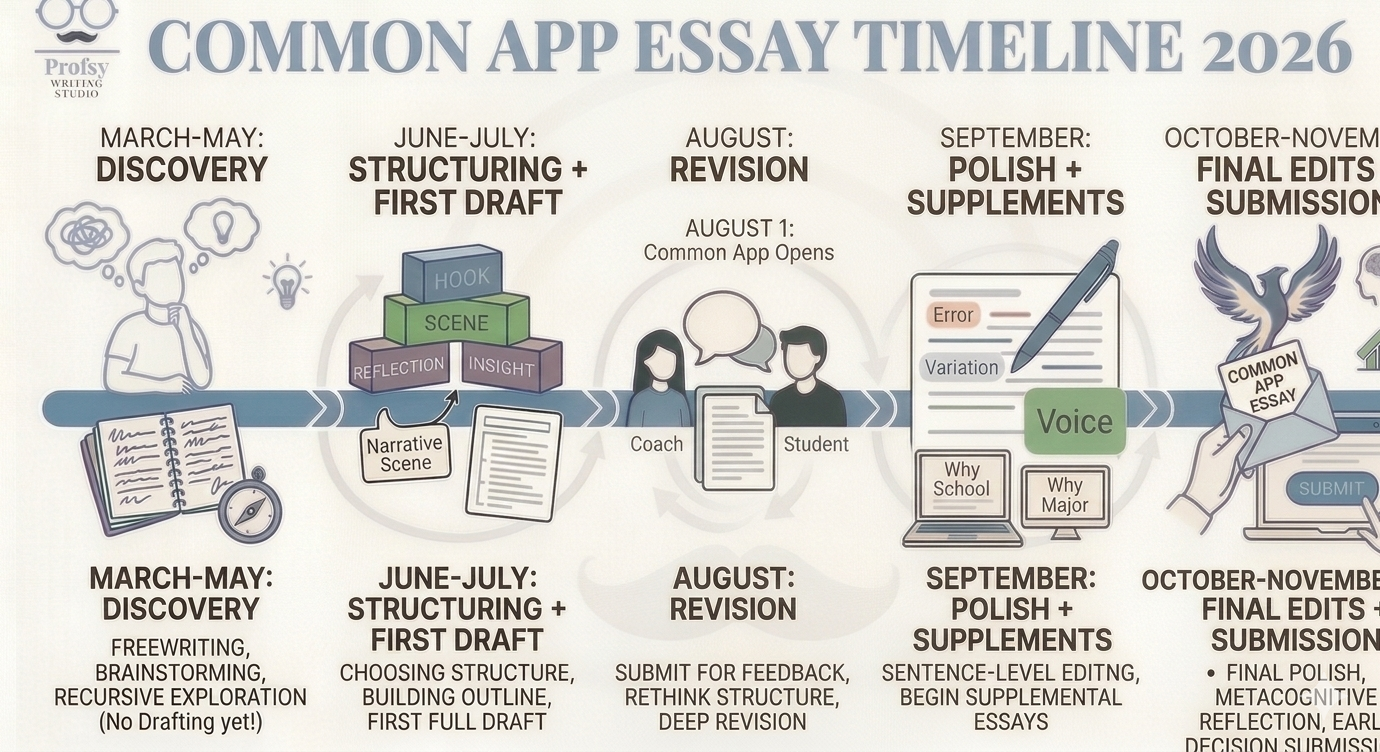
The Spring-to-Summer Timeline
Here's a realistic month-by-month plan for the 2026-2027 essay cycle.
March through May: Discovery. Explore topics using structured exercises like freewriting, brainstorming, and generative questioning. Try writing two or three different ideas. Don't commit to one idea or one structure yet. This is the phase that most students skip and also the one that is most crucial to finding what makes your essay really yours.
June and July: Structure and First Draft. By June, you should have a clear sense of your topic. Now choose a structure that fits your story. Build an outline. Write a first full draft. The only requirement is that it exists on the page. Quality comes later, in revision.
August: Revision. The Common App opens August 1. By now, if you have followed my advice—follow my advice!—you're revising a draft you've already written, which is a completely different experience from starting with a blank page. This is the part where you should be getting substantive feedback, rethinking your structure, and deepening your most important moments.
September: Polish and Supplementals. Sentence-level editing on the personal statement. Begin tackling supplemental essays (Why This School, Why This Major, Community, Activities, etc.). Most students don't think about the supplementals and then start them too late. September is the right time.
October and November: Final Edits and Submission. Early Decision deadlines hit in late October and early November. If you've been on this timeline, you're doing final polish rather than panicking over a first draft.
The danger of starting in September. This is when most families begin the essay process. Summer is the season when the pressure starts to build. Fall is when the students who didn't start early try to do everything at the same time in a three-to-four week sprint, brainstorming while they are drafting, revising while they brainstorm, getting feedback before they have a clear idea of what they want to say, finalizing while managing schoolwork and all the rest of the application process. Don't be one of them! That sort of pressure and compression produces dull, generic, unmemorable essays.
Starting in the spring will give your essay the breathing room it needs to be authentic and unique. It gives you more time to discover and shape an idea before the pressure of working under imminently approaching deadlines takes over. And more time to think is what separates essays that sound like everyone else's from essays that sound unmistakably like the student who wrote them. That's what makes it yours.
What Parents Can Do Right Now
If you're a parent reading this, your instinct is probably to want to help. That instinct is right. The challenge is finding the line between getting involved to support your kid and taking over too much control. Helping too much and helping too little can both be problematic. (You're already a parent, so you know all about this already.) With the application essay, one good goal is to be a supportive listener rather than a shaper of the final product.
In March and April, the most useful thing you can do is create space to get your kid started. Make it clear there's no pressure to produce a finished product yet, but that waiting until August is not the best strategy. Encourage your student to try a freewrite or two. Ask open-ended questions over dinner: "What's something you've learned about yourself this year?" Don't push for answers or assign topics. Just open the door.
In June and July, help with logistics. Keep track of school-specific supplemental essay requirements. Help your student build a calendar. If they're working with a coach, make sure sessions are scheduled. Stay close, but let the coach or the student drive the content. For a complete month-by-month breakdown with more detail on each phase, see our college essay timeline.
In August through November, read drafts if and when your kid asks you to. When you do, ask this question: "Does this sound like you?" That's the most useful feedback a parent can give. If the essay sounds like your kid, it's working. If it sounds like it was written by an adult or a committee, something is off and needs attention.
Protect your kid's authentic voice. This is worth its own paragraph. Wanting to help your kid is natural and absolutely the right instinct—and helping them a little too much is also so easy to do. Over-editing a student's essay, even with the best of intentions, can strip out the authentic voice admissions officers are specifically reading for. Your kid's natural way of expressing themselves, including some things that might not seem entirely correct, their regional expressions, conversational rhythms, and the vocabulary they actually use, all that is actually an asset. Admissions officers read thousands of essays. They read lots of essays that sound like they were polished by adults. The ones that stand out are the ones that sound like a real seventeen-year-old with something genuine to say.
When to consider outside support. If your kid is willing to work but keeps circling the same question for weeks ("I have no idea what to write about"), that's often the point where a coach can help unlock things. The issue probably isn't motivation. More likely, they need someone who can help them see the difference between a life experience and an essay topic, and who can ask the right questions to bridge that gap. A good coach can do it without taking over the student's voice or decisions.